 Profile 01
Businesses with a high volume of enquiries
Businesses that receive hundreds of similar messages or emails every week and want to reply quickly without the team constantly putting out fires.
AI agents · Custom development
Tasks completed, not just answers.
We build agents that understand a request, query your CRM, your ERP or your documents and carry out specific steps, with limited permissions, a log of every action and human approval for anything sensitive.


AI agents are useful when there is repetitive work that involves reading, deciding and acting across several systems: sorting requests, preparing quotes, checking orders or answering enquiries with real data. We start with a specific task, someone who owns it and a way to measure whether it is done well, not with the technology.
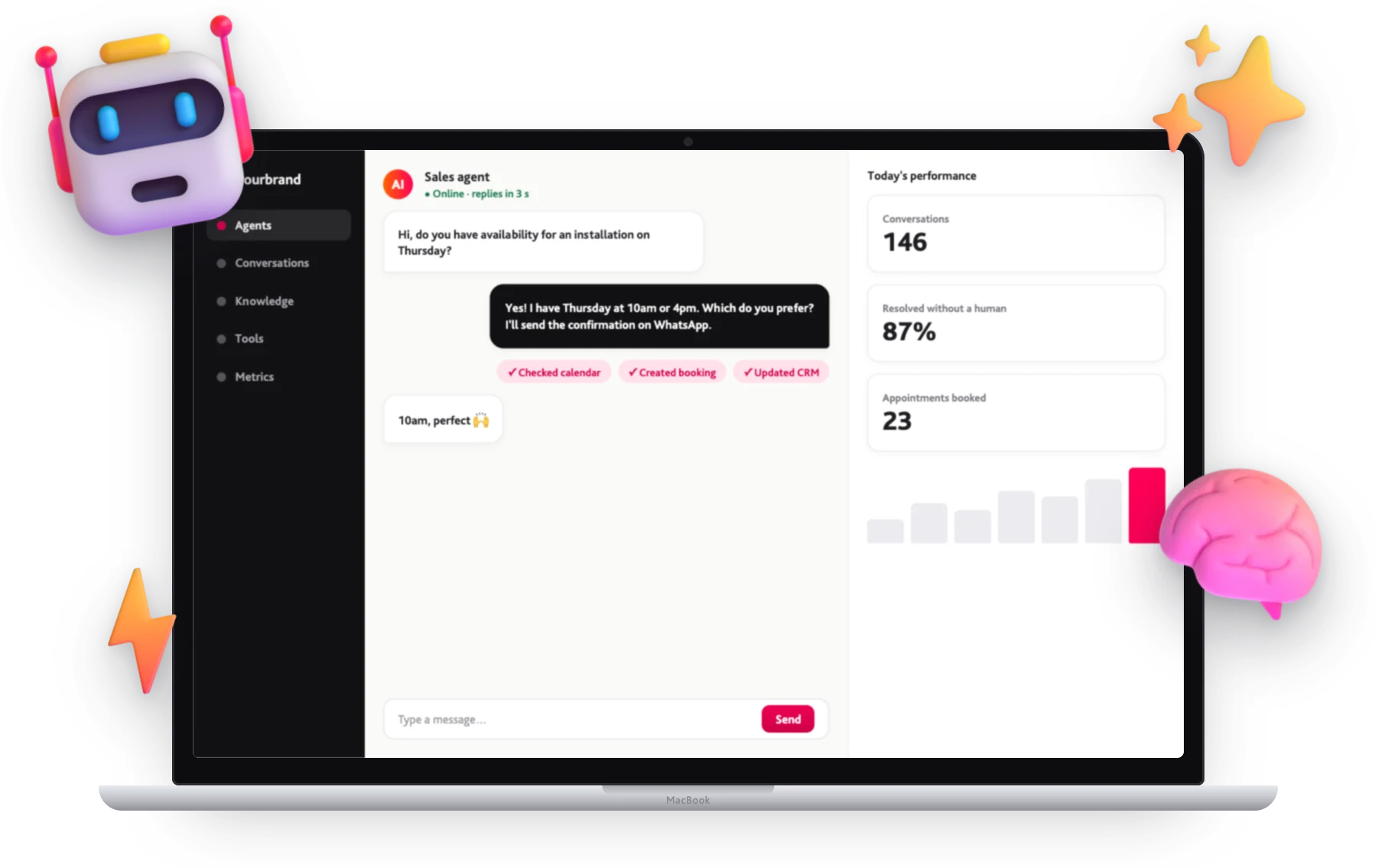
Our team has already built agents that are in production: an omnichannel CRM with an agent mode that handles conversations on WhatsApp, Instagram or web chat and hands over to a person when needed, and MCP connectors that let AI assistants work with Google Ads, Meta Ads and Xero. That experience taught us where agents fail and how to prevent it.
An agent can get things wrong, so we design it so that mistakes are noticed and corrected: minimum permissions, human approval for payments, data changes or delicate messages, a log of every action and a full set of tests before launch. It doesn't replace your team: it takes the mechanical work off their plate so they can spend their time on what needs judgement.
The challenge
Before we propose anything, we look at where money or time is being lost. These are the problems we find most often.


 Challenge 01
The prototype impresses in a meeting, but nobody defined what data it uses, what it can do or who is accountable when it gets something wrong, and the project ends up shelved.
 Challenge 02
Your team copies data from email to the CRM, from the CRM to a spreadsheet and from there to the ERP. Every jump adds minutes, errors and delays for the customer.
 Challenge 03
Giving an AI access to your customers, your payments or your data with no limits and no log is a real risk that no manager should accept blindly.
Challenge 04 A model with no access to your data and no prior testing can make up prices, timeframes or policies with complete confidence, and the mistake reaches the customer before it reaches you.
An agent earns its autonomy through testing, not promises.
What we do
Agents that handle enquiries, query your systems and carry out tasks, with clear rules and a person in charge.
 01
We review your processes with the people who do them every day and pick the tasks where an agent adds value: volume, clear rules and accessible data. We define what it can do on its own, what needs approval and what it will never do.
02 Agents that reply on WhatsApp, Instagram, email or web chat with real information from your catalogue, stock and orders, capture details, book appointments and hand the conversation over to your team with the full context.
03 Agents that read emails and documents, sort requests, draft quotes or reports and update the CRM or the ERP, always within the permissions you assign.
 04
We connect the agent to your tools through APIs and MCP servers with their own credentials, minimum permissions and test environments, so it can look things up and act without touching more than it needs to.
05 We put together a set of real cases, including the hard ones, and measure how the agent responds before opening it up to customers. We repeat the test with every change of model, instructions or data.
 06
A dashboard with the agent's conversations and actions, alerts when it hesitates or fails, human approval for anything sensitive and a monthly review with you to correct instructions and add tasks.
How we work
Each phase ends with a deliverable you review and approve, so you always know where your project stands.
We choose a specific task with your team, measure how it is done today and define what it means for the agent to do it well.
We decide on the model, data, tools, permissions and human approval points, and put it all in writing before we write any code.
We build a first version connected to test data and evaluate it with real cases until it responds and acts the way you expect.
We switch the agent on for a small group of users or with human approval on everything, and open up more autonomy as the results come in.
We review conversations, errors and metrics every month, adjust instructions and data, and add new tasks once the first ones are working.
What's included
What we measure and report
A monthly report in plain language and an up-to-date dashboard whenever you need it.
Who it's for
Profile 01 Businesses that receive hundreds of similar messages or emails every week and want to reply quickly without the team constantly putting out fires.
Profile 02 Teams that spend hours copying data between email, spreadsheets, CRM and ERP, and need those tasks done automatically and with a record.
Profile 03 Companies with a CRM, an ERP or a custom platform that want an agent that works with their data and their rules, not with a generic tool.
Industries where we use it most
Real projects
Projects by our team where this service played a key part.
See all workKeep exploring




Artificial intelligence
Our AI agents assessment shows you exactly what to improve first, with priorities and timelines.
FAQ
It depends on how many tasks it handles, how many systems it connects to and the level of control you need. There are two parts: development, which we quote at a fixed price after the assessment, and the running cost of the model and the infrastructure, which grows with volume and which we estimate before starting so there are no surprises on the monthly bill.
An agent with a tightly defined task and systems that already have an API can be in testing within a few weeks. What stretches a project out most is not the AI, but preparing data, permissions and integrations and gathering test cases. After the assessment we give you a phased timeline and roll out gradually.
A chatbot converses: it answers questions, usually with fixed information. An agent also uses tools to act: it checks an order in your system, books an appointment, creates a record in the CRM or prepares a document. That is why it needs something a chatbot doesn't: defined permissions, a log of actions and human approval for anything with consequences.
Yes. Language models can misread a request or make up a detail if they don't have the right information. That is why we connect the agent to your real sources, limit what it can do, require human approval for sensitive actions and test it with real cases before launch. After that we review its errors every month and fix them.
We define with you which data the agent can and cannot see, where it is stored and who has access to the logs. We work with the business APIs from OpenAI and Anthropic, which according to their terms do not use your data to train their models by default, and where needed we anonymise sensitive information before sending it.
That is not the goal and we don't promise it. An agent works well on repetitive tasks with clear rules; decisions that need judgement, exceptions and delicate conversations stay with your team. Typically the agent prepares, sorts or resolves the simple things, and people review and deal with what really calls for their experience.
Let's talk
We reply with specific questions and, if we're a good fit, a clear proposal: what we'd do, in what order, on what timeline and for what budget.
We reply within one business day with what we need to know.
A 30-minute meeting to understand your business and your goals.
A written proposal with plan, timeline and fixed budget.
Ask AI about us
 Loguimark