 Profile 01
Teams with a lot of documentation
Businesses with manuals, procedures, spec sheets or internal policies that their team consults daily and struggles to find.
AI on your data · RAG and MCP
What your business knows, one question away.
We build assistants that search your documents, contracts, manuals or meetings and query your systems in real time, respecting each person's permissions and citing where every answer comes from.

AI on your data answers with your business's information instead of improvising. A model like ChatGPT or Claude knows a lot in general, but it doesn't know your prices, your contracts or what was agreed at the last meeting; if you ask, it may make up a convincing answer. The solution is to give it controlled access to your sources.
RAG (retrieval-augmented generation) works like a good librarian: for each question, it finds the relevant paragraphs in your documents and hands them to the model, which answers citing the source. MCP (Model Context Protocol) is an open standard, now under the Linux Foundation, that lets you connect assistants such as Claude or ChatGPT to your systems to look up data in real time or carry out permitted actions.
We have done it in-house: an internal client hub with AI search across meeting transcripts, built with Django, Next.js and PostgreSQL with pgvector, and MCP connectors that let AI assistants work with Google Ads, Meta Ads and Xero. Always with the same rule: the assistant only accesses what the person asking is allowed to see.
The challenge
Before we propose anything, we look at where money or time is being lost. These are the problems we find most often.

 Challenge 01
The important answers are in the heads of two or three people or lost in emails, and every question interrupts whoever has the most work on.
 Challenge 02
Manuals, contracts, spec sheets and meeting minutes spread across folders, Drive and email, with duplicate versions and no search that understands what you are asking.
 Challenge 03
General-purpose assistants answer confidently about prices, policies or customers they know nothing about, and nobody can check where the answer came from.
 Challenge 04
Copying customer information into AI tools with no permissions or logging exposes personal data and trade secrets to people who shouldn't see them.
An answer without a source is an opinion; with a source, it is information.
What we do
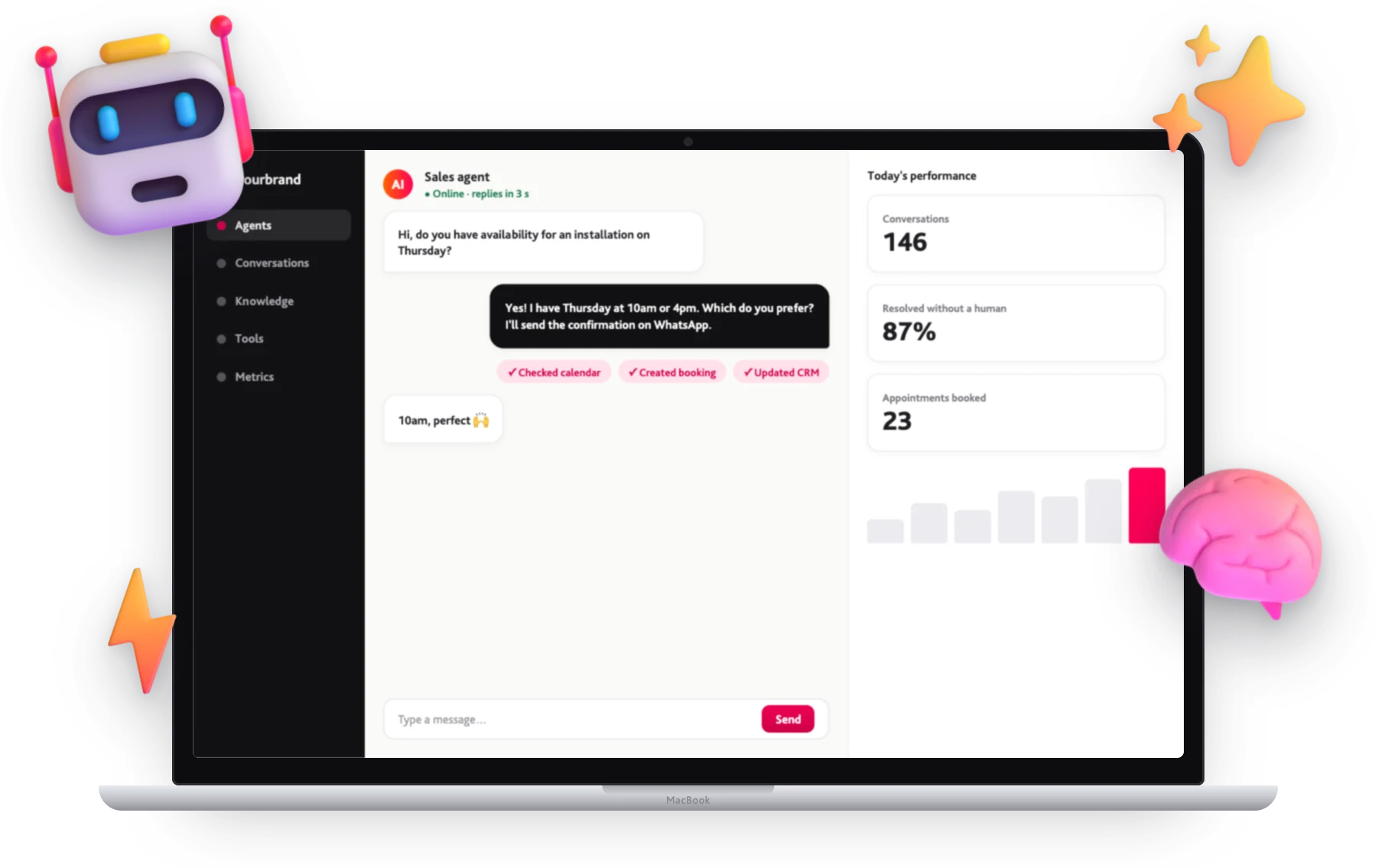
Assistants that answer from your documents and query your systems using RAG and MCP, citing the source.
 01
We identify which documents and systems the assistant should draw on, who can see what, what is out of date and which sensitive data should be excluded or anonymised before we start.
02 We prepare your documents, split them into chunks, create a semantic index in PostgreSQL with pgvector and configure the assistant to answer only with what it finds, citing the source.
03 We develop MCP connectors so that Claude, ChatGPT or other assistants can query your CRM, ERP, advertising platforms or accounting software with defined permissions, as we have already done with Google Ads, Meta Ads and Xero.
 04
The assistant inherits the permissions of whoever is asking: a salesperson doesn't see payroll and a client doesn't see another client's data. Every query is logged for auditing.
 05
Before launch, we put together a bank of real questions with their correct answers and measure whether the assistant finds the right source, answers well and recognises when it doesn't know.
 06
We sync the sources so the index updates when documents change, review unanswered questions and adjust the system with you every month.
How we work
Each phase ends with a deliverable you review and approve, so you always know where your project stands.
We define which questions the assistant should answer, for whom and with which documents and systems.
We clean, organise and index the documents, and design the MCP connectors or APIs for real-time data.
We test with real questions from your team and measure correct answers, correct citations and "I don't know" responses.
We roll it out on the channel you use, such as an intranet site, your company chat or your own software, with roles and logging.
Every month we review unanswered questions and errors, add sources and fine-tune the search.
What's included
What we measure and report
A monthly report in plain language and an up-to-date dashboard whenever you need it.
Who it's for
Profile 01 Businesses with manuals, procedures, spec sheets or internal policies that their team consults daily and struggles to find.
Profile 02 Teams that answer technical or policy questions and need consistent, sourced answers in seconds.
Profile 03 Organisations that work with AI assistants and want to connect them securely to their CRM, their ERP or their accounting software through MCP.
Industries where we use it most
Real projects
Projects by our team where this service played a key part.
See all workKeep exploring


Artificial intelligence
Our assessment for AI on your data (RAG and MCP) shows you exactly what to improve first, with priorities and timelines.
FAQ
RAG is for consulting written knowledge: the system searches your documents for the relevant passages and the model answers from them, citing the source. MCP is for connecting the assistant to live systems, such as a CRM, an ERP or an advertising account, and looking up current data or carrying out permitted actions. Many projects combine the two.
With RAG and MCP no model is retrained: your data is looked up at the moment of each question and stays in your systems or in a database under your control. We work with the business APIs from OpenAI and Anthropic, which according to their terms do not use that data for training by default. Even so, we exclude or anonymise the most sensitive information.
It depends on the volume and condition of your documents, how many systems need connecting and the level of permissions you need. There is a development cost, which we quote at a fixed price after reviewing your sources, and a monthly running cost for the model and infrastructure, which we estimate before starting based on the expected number of queries.
It can happen, though far less often. That is why we configure it to answer only with what it finds, always cite the source and say "I don't know" when the information isn't there. Before launch we evaluate it with a bank of real questions and, afterwards, we review the doubtful answers to correct the search, the documents or the instructions.
An MCP server is a connector that exposes a system's data and actions, with permissions, so an AI assistant can use them. You need one if you want Claude, ChatGPT or another assistant to query your CRM, your campaigns or your accounts without copying and pasting. We build it to measure and you decide what it can read and what it can do.
Almost any source with text or an API: PDFs, Word documents, spreadsheets, Google Drive, internal wikis, support tickets, meeting transcripts, CRM, ERP or invoicing software. In the initial inventory we review the format and quality of each source, and tell you which ones add value and which should be cleaned up first.
Let's talk
We reply with specific questions and, if we're a good fit, a clear proposal: what we'd do, in what order, on what timeline and for what budget.
We reply within one business day with what we need to know.
A 30-minute meeting to understand your business and your goals.
A written proposal with plan, timeline and fixed budget.
Ask AI about us
 Loguimark